

Mastering AI-Driven Test Data Generation for REST Assured APIs in CI/CD Pipelines: A Java & TestNG Deep Dive
Mastering AI-Driven Test Data Generation for REST Assured APIs in CI/CD Pipelines: A Java & TestNG Deep Dive
In the fast-paced world of software development, ensuring the reliability and robustness of APIs is paramount. RESTful APIs form the backbone of countless applications, and effective testing is crucial for their success. While traditional test data generation methods often fall short in complexity and coverage, Artificial Intelligence (AI) is emerging as a game-changer, offering sophisticated solutions for creating realistic and diverse test data. This article delves into how AI can revolutionize test data generation for REST Assured APIs, seamlessly integrating into your CI/CD pipelines using Java and TestNG.
The Challenge of Test Data Generation in API Testing
Testing REST Assured APIs effectively requires a vast array of test data. Manual data creation is tedious, error-prone, and rarely covers all edge cases. Traditional automated approaches, such as using static files or simple data generators, often lack the dynamism and realism needed for comprehensive testing. This leads to:
- Limited Test Coverage: Inability to explore diverse scenarios and edge cases.
- Maintenance Headaches: Static data becomes outdated quickly with API changes.
- Bottlenecks in CI/CD: Data generation becomes a slow, manual step, hindering rapid deployments.
- Production Data Dependency: Relying on production data raises privacy and security concerns.
Why AI for Test Data Generation?
AI-driven test data generation addresses these challenges by leveraging machine learning algorithms to understand data patterns, identify anomalies, and create synthetic data that is both realistic and diverse. This approach offers several compelling advantages:
- Enhanced Realism: AI can learn from existing data (without using sensitive production data directly) to generate data that mimics real-world usage patterns.
- Superior Coverage: Algorithms can intelligently explore the data space, generating edge cases and boundary conditions that might be missed by human testers.
- Dynamic Adaptation: AI models can adapt to changes in API schemas or business logic, automatically generating relevant new data.
- Scalability and Speed: Automating data generation significantly accelerates testing cycles, crucial for CI/CD environments.
- Data Privacy Compliance: Synthetic data eliminates the need for sensitive production data in non-production environments, aiding compliance with regulations like GDPR or HIPAA.
Integrating AI-Driven Data Generation with REST Assured in Java
REST Assured is a powerful Java library for testing RESTful services. Combining it with AI-driven data generation creates a formidable testing framework. Here's a conceptual overview and practical steps:
1. Understanding the AI Data Generation Process
At its core, AI data generation involves:
- Data Profiling: Analyzing existing (non-sensitive) data or API schemas to understand data types, formats, relationships, and constraints.
- Model Training: Using techniques like Generative Adversarial Networks (GANs), Variational Autoencoders (VAEs), or simpler statistical models to learn data distributions.
- Synthetic Data Generation: Producing new, artificial data points based on the trained model.
2. Setting Up Your Java Project (Maven/Gradle)
Ensure your pom.xml (Maven) or build.gradle (Gradle) includes necessary dependencies:
<!-- Maven Example -->
<dependencies>
    <dependency>
        <groupId>io.rest-assured</groupId>
        <artifactId>rest-assured</artifactId>
        <version>5.3.0</version>
        <scope>test</scope>
    </dependency>
    <dependency>
        <groupId>org.testng</groupId>
        <artifactId>testng</artifactId>
        <version>7.8.0</version>
        <scope>test</scope>
    </dependency>
    <!-- Add dependencies for AI data generation libraries if available,
         or your custom AI data generation module -->
    <!-- Example: A custom library or a data faker library like JavaFaker
         can be augmented with AI logic -->
    <dependency>
        <groupId>com.github.javafaker</groupId>
        <artifactId>javafaker</artifactId>
        <version>1.0.2</version>
    </dependency>
</dependencies>
<!-- Maven Example -->
<dependencies>
    <dependency>
        <groupId>io.rest-assured</groupId>
        <artifactId>rest-assured</artifactId>
        <version>5.3.0</version>
        <scope>test</scope>
    </dependency>
    <dependency>
        <groupId>org.testng</groupId>
        <artifactId>testng</artifactId>
        <version>7.8.0</version>
        <scope>test</scope>
    </dependency>
    <!-- Add dependencies for AI data generation libraries if available,
         or your custom AI data generation module -->
    <!-- Example: A custom library or a data faker library like JavaFaker
         can be augmented with AI logic -->
    <dependency>
        <groupId>com.github.javafaker</groupId>
        <artifactId>javafaker</artifactId>
        <version>1.0.2</version>
    </dependency>
</dependencies>
3. Implementing AI-Driven Data Generation (Conceptual)
While a full AI model implementation is beyond a single blog post, you can integrate AI-like intelligence using existing libraries or custom logic. For instance, you could use JavaFaker for basic data and then apply AI-driven rules or patterns on top of it. For advanced AI, you'd typically integrate with a dedicated synthetic data platform or a custom ML model exposed via an internal API.
Let's consider a simplified approach where a 'smart' data generator learns patterns:
import com.github.javafaker.Faker;
import java.util.Locale;
import java.util.Random;

public class AIDataGenerator {
    private static final Faker faker = new Faker(new Locale("en-AU")); // Example: Use a specific locale
    private static final Random random = new Random();

    public static String generateProductName() {
        // Simulate AI learning: products often have specific prefixes/suffixes
        String[] prefixes = {"Smart", "Eco", "Pro", "NextGen"};
        String[] suffixes = {"Hub", "Connect", "Vision", "Core"};
        if (random.nextBoolean()) {
            return prefixes[random.nextInt(prefixes.length)] + " " + faker.commerce().productName();
        } else if (random.nextBoolean()) {
            return faker.commerce().productName() + " " + suffixes[random.nextInt(suffixes.length)];
        }
        return faker.commerce().productName();
    }

    public static double generatePrice() {
        // Simulate AI learning: prices often cluster around certain values or have specific distributions
        return Math.round((faker.number().randomDouble(2, 10, 1000) + random.nextGaussian() * 50) * 100.0) / 100.0;
    }

    public static String generateValidEmail() {
        // Simulate AI learning: common email patterns, ensuring valid domains
        String[] domains = {"example.com", "test.org", "mail.net"};
        return faker.name().firstName().toLowerCase() + "." +
               faker.name().lastName().toLowerCase() +
               faker.number().digits(3) + "@" +
               domains[random.nextInt(domains.length)];
    }

    // More complex AI integration would involve calling an external service
    // or a locally trained model here.
}
import com.github.javafaker.Faker;
import java.util.Locale;
import java.util.Random;

public class AIDataGenerator {
    private static final Faker faker = new Faker(new Locale("en-AU")); // Example: Use a specific locale
    private static final Random random = new Random();

    public static String generateProductName() {
        // Simulate AI learning: products often have specific prefixes/suffixes
        String[] prefixes = {"Smart", "Eco", "Pro", "NextGen"};
        String[] suffixes = {"Hub", "Connect", "Vision", "Core"};
        if (random.nextBoolean()) {
            return prefixes[random.nextInt(prefixes.length)] + " " + faker.commerce().productName();
        } else if (random.nextBoolean()) {
            return faker.commerce().productName() + " " + suffixes[random.nextInt(suffixes.length)];
        }
        return faker.commerce().productName();
    }

    public static double generatePrice() {
        // Simulate AI learning: prices often cluster around certain values or have specific distributions
        return Math.round((faker.number().randomDouble(2, 10, 1000) + random.nextGaussian() * 50) * 100.0) / 100.0;
    }

    public static String generateValidEmail() {
        // Simulate AI learning: common email patterns, ensuring valid domains
        String[] domains = {"example.com", "test.org", "mail.net"};
        return faker.name().firstName().toLowerCase() + "." +
               faker.name().lastName().toLowerCase() +
               faker.number().digits(3) + "@" +
               domains[random.nextInt(domains.length)];
    }

    // More complex AI integration would involve calling an external service
    // or a locally trained model here.
}
4. Integrating with REST Assured and TestNG
Now, let's use this AIDataGenerator within a TestNG test for a REST Assured API.
import io.restassured.RestAssured;
import io.restassured.http.ContentType;
import org.testng.annotations.BeforeClass;
import org.testng.annotations.DataProvider;
import org.testng.annotations.Test;

import static io.restassured.RestAssured.given;
import static org.hamcrest.Matchers.equalTo;

public class ProductAPITest {

    @BeforeClass
    public void setup() {
        RestAssured.baseURI = "http://localhost:8080"; // Replace with your API base URI
        RestAssured.basePath = "/api/products";
    }

    @DataProvider(name = "productData")
    public Object[][] getProductData() {
        // Generate 5 sets of AI-driven test data
        Object[][] data = new Object[5][3];
        for (int i = 0; i < 5; i++) {
            data[i][0] = AIDataGenerator.generateProductName();
            data[i][1] = AIDataGenerator.generatePrice();
            data[i][2] = AIDataGenerator.generateValidEmail(); // Example for a creator email
        }
        return data;
    }

    @Test(dataProvider = "productData", description = "Verify product creation with AI-generated data")
    public void testCreateProductWithAIData(String productName, double price, String creatorEmail) {
        String requestBody = String.format(
                "{\"name\": \"%s\", \"price\": %.2f, \"creatorEmail\": \"%s\"}",
                productName, price, creatorEmail
        );

        given()
            .contentType(ContentType.JSON)
            .body(requestBody)
        .when()
            .post()
        .then()
            .statusCode(201) // Assuming 201 Created for successful post
            .body("name", equalTo(productName))
            .body("price", equalTo((float) price)); // JSON numbers might be float/double

        System.out.println("Created product: " + productName + ", Price: " + price + ", Creator: " + creatorEmail);
    }

    // Add more tests for update, delete, get with AI-generated IDs or search terms
}
import io.restassured.RestAssured;
import io.restassured.http.ContentType;
import org.testng.annotations.BeforeClass;
import org.testng.annotations.DataProvider;
import org.testng.annotations.Test;

import static io.restassured.RestAssured.given;
import static org.hamcrest.Matchers.equalTo;

public class ProductAPITest {

    @BeforeClass
    public void setup() {
        RestAssured.baseURI = "http://localhost:8080"; // Replace with your API base URI
        RestAssured.basePath = "/api/products";
    }

    @DataProvider(name = "productData")
    public Object[][] getProductData() {
        // Generate 5 sets of AI-driven test data
        Object[][] data = new Object[5][3];
        for (int i = 0; i < 5; i++) {
            data[i][0] = AIDataGenerator.generateProductName();
            data[i][1] = AIDataGenerator.generatePrice();
            data[i][2] = AIDataGenerator.generateValidEmail(); // Example for a creator email
        }
        return data;
    }

    @Test(dataProvider = "productData", description = "Verify product creation with AI-generated data")
    public void testCreateProductWithAIData(String productName, double price, String creatorEmail) {
        String requestBody = String.format(
                "{\"name\": \"%s\", \"price\": %.2f, \"creatorEmail\": \"%s\"}",
                productName, price, creatorEmail
        );

        given()
            .contentType(ContentType.JSON)
            .body(requestBody)
        .when()
            .post()
        .then()
            .statusCode(201) // Assuming 201 Created for successful post
            .body("name", equalTo(productName))
            .body("price", equalTo((float) price)); // JSON numbers might be float/double

        System.out.println("Created product: " + productName + ", Price: " + price + ", Creator: " + creatorEmail);
    }

    // Add more tests for update, delete, get with AI-generated IDs or search terms
}
Integrating into CI/CD Pipelines
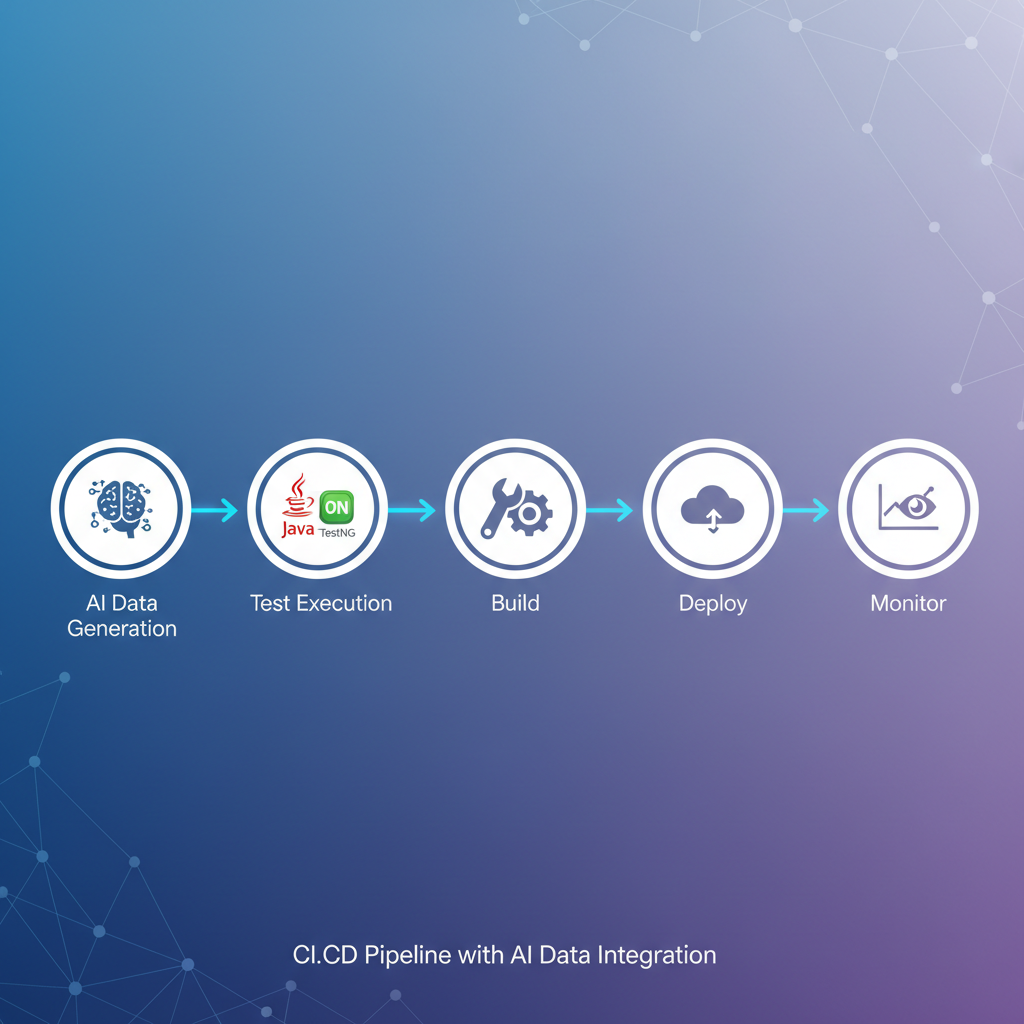
For seamless integration into CI/CD, consider these points:
- Automated Execution: Configure your CI/CD tool (Jenkins, GitLab CI, GitHub Actions, Azure DevOps) to run your TestNG tests automatically on every code commit or pull request.
- Dynamic Data Generation: The AI data generation component should be triggered as part of the test execution phase. This ensures fresh, relevant data for each pipeline run.
- Reporting: Integrate reporting tools (e.g., ExtentReports, Allure) to visualize test results and data coverage.
- Environment Management: Ensure your test environment is properly configured to handle the volume and variety of AI-generated data.
Best Practices for AI-Driven Test Data Generation
- Start Small: Begin with a specific API or data subset to prove the concept before scaling.
- Data Anonymization: If using any form of production data for training, ensure it's rigorously anonymized and de-identified.
- Feedback Loop: Implement mechanisms to feed test results back into your AI model to refine data generation over time.
- Version Control: Keep your data generation logic and any AI model configurations under version control.
- Performance Considerations: Generating large volumes of complex synthetic data can be resource-intensive. Optimize your generation process.
- Validation: Always validate the synthetic data against business rules and API schema constraints to ensure its usability.
Elevate Your Skills with AdvanseIT's Java Selenium & AI Test Automation Training
Mastering advanced testing techniques like AI-driven data generation requires a strong foundation in test automation. At AdvanseIT, we understand the evolving landscape of QA and offer comprehensive training programs designed to equip you with cutting-edge skills. Our Java Selenium & AI Test Automation Training is a live, instructor-led program available online globally, perfect for QA engineers, test leads, and developers looking to excel.
This intensive program features 60 live sessions over 9 weeks, providing deep dives into Java, Selenium WebDriver, TestNG, API testing with REST Assured, and an introduction to AI concepts in testing. We offer two flexible plans: the Live Class for AUD $399, providing real-time interaction and support, and the Recording Only plan for AUD $249, allowing you to learn at your own pace. Upskill with industry experts and propel your career forward. Visit AdvanseIT Java Selenium Training to learn more and enroll today!
Conclusion
AI-driven test data generation represents a significant leap forward in API testing, offering unparalleled realism, coverage, and efficiency. By integrating these advanced techniques with REST Assured and TestNG in your Java-based CI/CD pipelines, you can build more robust, reliable, and future-proof applications. As a leader in IT solutions, including web design, app development, AI, and testing, AdvanseIT empowers organizations and individuals to harness the full potential of technology. Embrace AI in your testing strategy and transform your QA processes.
For further insights or to explore how AdvanseIT can assist with your specific AI and testing needs, feel free to reach out to our experts. We're here to help you navigate the complexities of modern software development and testing. Contact us at https://advanseit.com.au/contact.
Related Images


Ready to transform your business with AI-first IT?
AdvanseIT delivers cost-effective web, app, AI, and staffing solutions from Brisbane.
Get a Free Consultation